
Meeting Manager · from the Selltech Suite
Most meetings don't stand alone. Neither should their notes.
Other note-takers write up one meeting at a time. Meeting Manager groups recurring and follow-on meetings into their series, so you see the whole story and the actions carry forward on their own. And every meeting is written up for what it was for, because an interview is not a project meeting.
Project meeting · Meeting 3
Decisions and risks
Room layout signed off. AV quote still open, first raised in meeting one. Catering numbers needed before the next meeting.
Actions carried through the series
- Send final floorplan to the venueMtg 3Sarah · Thu
- Chase the AV supplier’s quoteMtg 1Tom · Mon
- Confirm speaker travel (not in meeting)Mtg 2Priya · Fri
What makes it different
Every note-taker summarises. Meeting Manager connects.
A summary, an action list and a chat box are standard now. They are where we start, not what we sell. The value is in what a one-meeting-at-a-time note-taker can’t do.
A typical note-taker
- A summary
- An action list
- A chat box
- For one meeting at a time
Meeting Manager
01
Meetings in a series, never in isolation.
Projects aren’t run in one meeting, so you shouldn’t have to read them one meeting at a time. Meeting Manager takes the holistic view.
The whole story, not one hour of it
Recurring and follow-on meetings are grouped into their series, by client and project. A one-off meeting is simply written up on its own. Meeting three opens with what meetings one and two decided, the issues that keep coming back, and what is still open.
Actions travel with the series
Nobody has to write up or chase actions one meeting at a time. They belong to the series, so they carry into the next meeting, stay open until they’re done, and can go to someone who wasn’t in the room.
Spring Summit · project meetings
Meeting 1
Chase AV quote
RaisedMeeting 2
Chase AV quote
Still openMeeting 3
Chase AV quote
Overdue, flaggedOne action, followed across the series
Nobody re-typed it, re-assigned it or remembered to ask. It came with the series.
02
Written up for the type of meeting.
Different meetings have different purposes, so why would the write-up be the same? Each meeting type gets its own write-up, built for what that meeting is for.
Interview
- Red, amber and green flags
- Follow-up questions for the next round
- Keep going, stop or hire
Project meeting
- Decisions made
- Risks and open issues
- Actions by owner and date
Training session
- Key lessons
- What each person will practise
- Questions for the next session
Pipeline review
- Deals discussed
- What has changed since the last review
- The next step for each deal
Ask one meeting, or the whole series
Keep a question to the last meeting, or ask it across the series and see how things have moved.
Notes you can share
Send the write-up to the people who need it, without copying and pasting from a transcript.
The problem
“I thought you were doing that.” So who actually agreed to what?
It’s Monday’s project catch-up, six weeks before the summit. Last week there was a venue walk-through, a supplier call and a speaker briefing, each with different people in the room. Nobody can say what was agreed about the layout, who is chasing the AV quote, or when the catering numbers are due. The detail is spread across three people’s notebooks and inboxes.
Ten days later the venue emails: “We were expecting your final floorplan last Friday.” Nobody knew it was theirs to send.
Where the detail lives today
Actions fall between meetings
What was agreed at the venue meeting never reaches the person who has to do it.
Meeting two repeats meeting one
Time goes on re-establishing what was already agreed.
Projects leave with people
When someone moves on, the history of the project goes with them.
Projects scatter
The venue meetings, supplier calls and speaker briefings for one event end up in five different places.
Training doesn’t stick
What a session covered is forgotten by the next one, because nobody wrote it down.
The same Monday, with Meeting Manager
Nobody did anything except turn up to the meetings.
Before the catch-up, the project lead opens the Spring Summit series: every meeting in order, what each one decided, the AV worry that has come up in three of them, and the actions carried forward from every meeting. One item is overdue and already flagged, and it belongs to someone who was never in the room. The catch-up is about what to do next, not what happened.
What was said
Who was there
What was promised
How it works
Four steps. Only the first one is yours.
Meet as normal
In person, on a call or from your calendar. The meeting comes in and joins its series, under its client, project and meeting type.
Get the right write-up
Minutes later: takeaways written for that kind of meeting, the decisions, and what each person promised to do.
Nothing slips
Actions carry forward through the series and are chased, whoever they belong to. Share the notes with anyone who needs them.
Ask anything
Ask the last meeting, or the whole series at once, and get the answer with the evidence attached.
Works with your call recorder and calendar.
Ask the series
Ask one question across the whole series.
In an events business, the answer has always been spread across hundreds of meetings in a dozen people’s heads. Now you can ask, and get the answer in the words people actually used.
One answer, with the evidence attached
Each point links back to what was said, so a manager can check it rather than take it on trust.
- “Which actions are still open from the last three meetings?”
- “What has come up again and again in this quarter’s training sessions?”
What it notices that a skim-read misses
The promise hidden in a friendly aside
The commitments people make mid-sentence, the ones humans consistently miss.
The same issue, raised in different meetings
The AV worry mentioned at the venue walk-through, the supplier call and the project catch-up, by three different people. Nobody else was in all three.
What wasn’t said
The subject that was raised, then quietly changed.
It reads conversations in the language of the events business, not as generic meetings.
Interviews too
Second interviews that don’t start from scratch.
Most second-round interviews repeat the first, because different people are in the room. Meeting Manager prepares every interview, carries what was learned into the next round, and audits each one, so hiring decisions rest on the whole picture.
The audit for one candidate
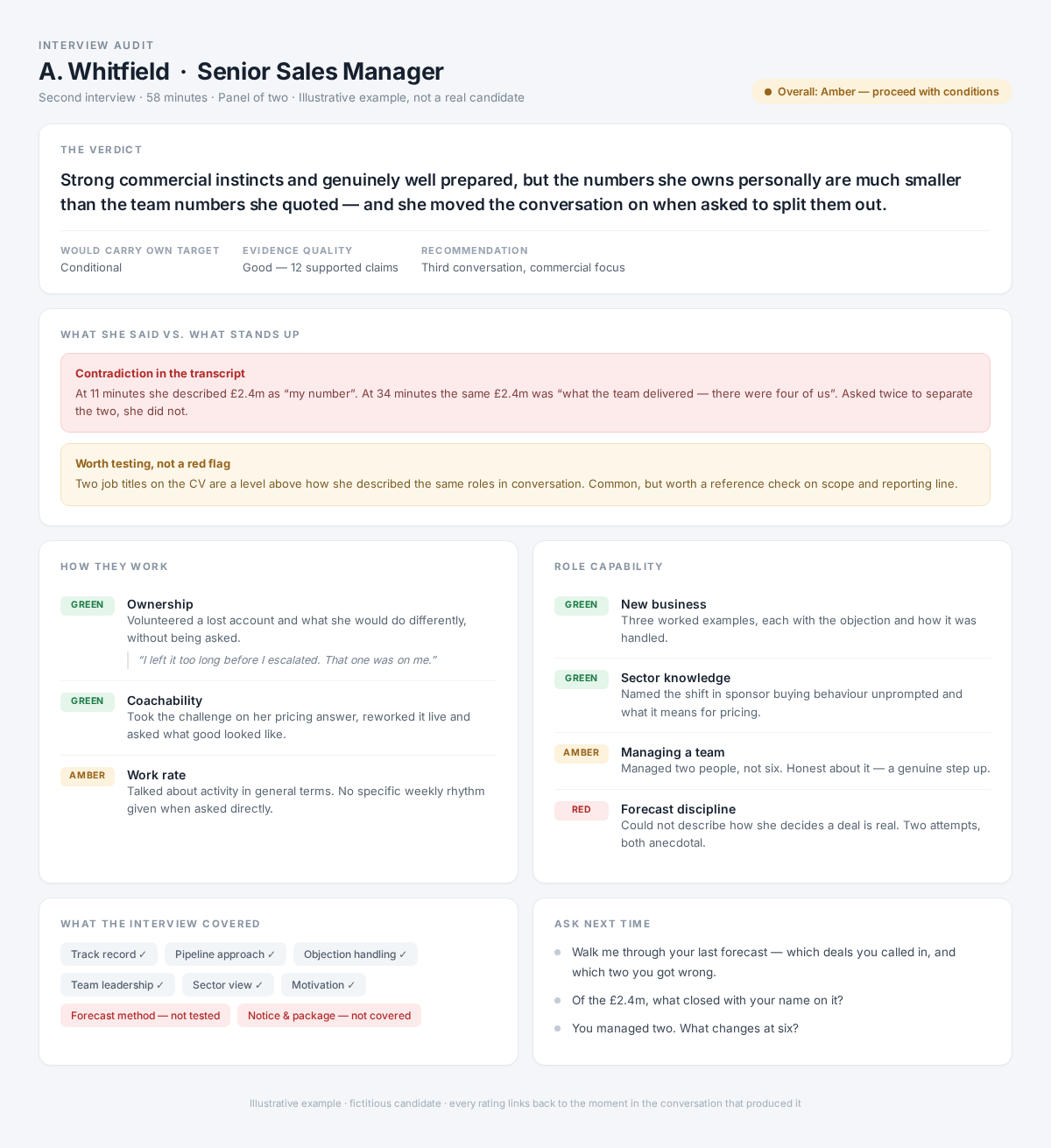
Prepared before you walk in
It reads the CV and the candidate’s online profile, checks them against the job description, and raises questions wherever something doesn’t fit. Proven questions from the interview library fill the gaps.
Round two builds on round one
New interviewers see what happened last time and get follow-up questions drawn from the earlier conversation, so the next round goes deeper instead of starting again.
An audit after every round
A full write-up with red, amber and green flags, and a recommendation: keep interviewing, stop, or hire.
Candidates side by side
Compare everyone at the same stage on the same terms, with an integrity check that looks for obfuscation, inconsistency and avoidance.
Then put your final two side by side.
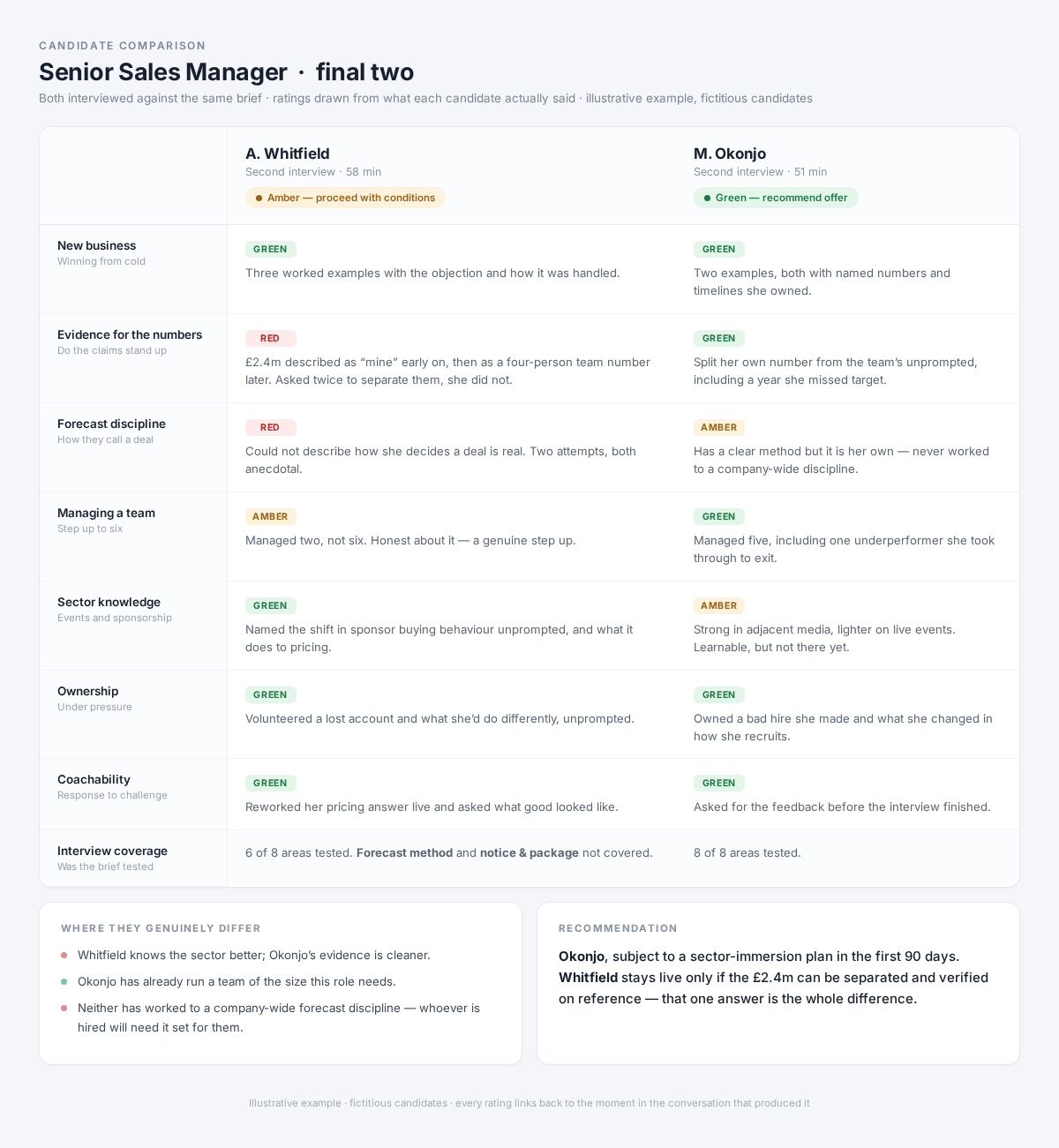
Also works for customer-research interviews: every conversation written up the same way, then questioned together. Recommendations support your hiring decision; they never make it.
What your team stops doing
- Writing up notes after every meeting
- Chasing people for “what did we agree?”
- Re-listening to recordings to find one thing
- Rebuilding a project’s history from an email trail
- Asking a leaver to “write up everything you know”
- Assembling the weekly status report by hand
Better with Mentor
Sales conversations belong in Mentor.
Meeting Manager runs your projects, training and internal meetings. Mentor looks after your sales conversations. When a sales call is recorded, it goes straight to Mentor, so coaching starts on its own. You don’t need both to get value from one.
Meet MentorHonest answers
The questions we hear most.
“My team won’t record their meetings.”
This is the real hurdle, not the technology. It works when the manager records their own meetings first and runs one project catch-up from it, so the team sees it saves them work. Start with one team, not the whole company.
“We already have a note-taker.”
A note-taker gives you the same summary of one meeting, whatever kind of meeting it was. Meeting Manager puts each recurring or follow-on meeting in its series, carries the actions forward with it, and writes each one up for what that type of meeting is for. The value is in the series, not the single meeting.
One forgotten follow-up pays for it.
One missed supplier deadline, or one promise to a client that nobody picked up, can cost more than the software. Projects rarely go wrong through one big mistake. They go wrong through the small thing everyone thought someone else was doing.
Getting started
A short setup, not a data-migration project.
- 1Set up: we create your organisation, add your people, and connect your calendar and call recorder.
- 2First meetings: your team meets as normal. Summaries and actions arrive the same day, after a short walkthrough.
- 3Make it the habit: run one project catch-up from Meeting Manager instead of from memory. That’s the moment it lands.
See it on your own conversation.
Book a 20-minute walkthrough with Iain. Bring one real recorded meeting and watch your own summary, actions and account view come out of it.
Book a walkthroughPrivate by default
The person who owns a meeting decides who else sees it.
One login. Your team. Kept separate.
One Selltech sign-in for every tool, controlled centrally. Remove someone once and they’re removed everywhere.
Your data stays yours
Each client’s data is kept separate and checked on every request. Connections are encrypted.